
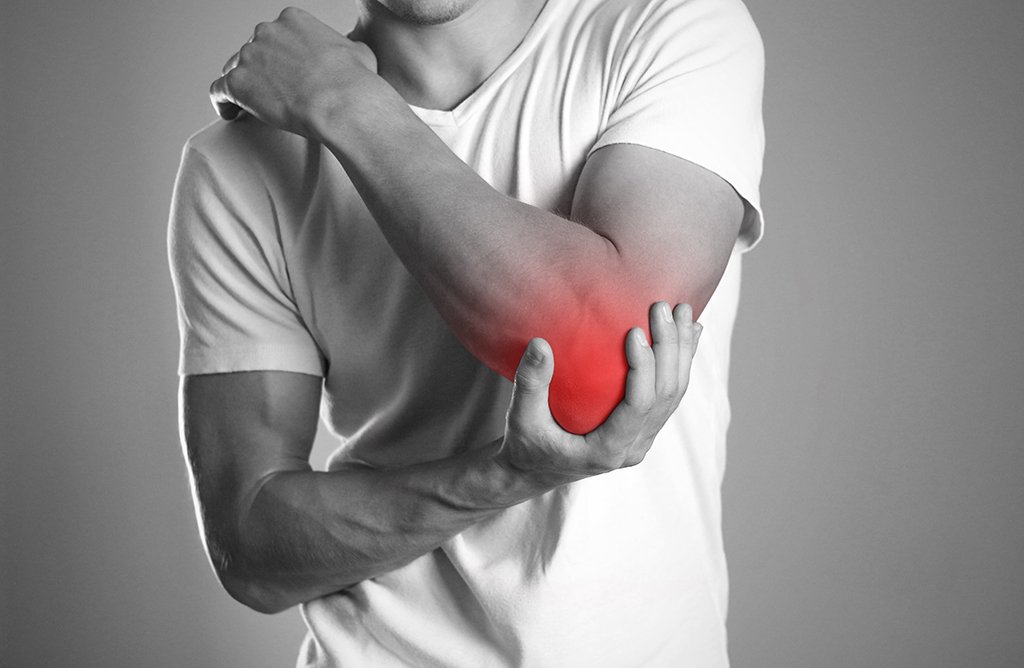
If you have pain on the outer (lateral) or inner (medial) side of the elbow, you may have tennis elbow or golfer’s elbow. Both conditions are often due to overuse of tendons that attach just above the elbow joint. In tennis elbow, the overuse is due to repetitive wrist extension, while in golfer’s elbow there is usually repetitive wrist flexion.
The symptoms of tennis and golfer’s elbow can resolve with a few techniques that are explained below but what if the elbow symptoms persist, or you cannot easily discontinue the aggravating movements? In such cases, seeing an osteopath for your elbow pain is the way forward.
What causes tennis elbow & golfer’s elbow?
Tennis elbow, medically known as lateral epicondylitis, and golfer’s elbow, referred to as medial epicondylitis, are repetitive strain injuries (RSI’s).
In tennis elbow, an overuse of the tendons results from repetitive or forceful wrist extension, whilst golfer’s elbow is due to repetitive or forceful wrist flexion. The reason for this is that many of the muscles whose tendons insert around the elbow are responsible for wrist, not elbow movement. Over exertion through the tendons might also irritate their attachment to the bony surface resulting in periosteal (bony) pain.
Whilst tennis and golfer’s elbow are often attributed to sporting activity they are not exclusively the result of the sport they are named after. More often, other daily actions in the working environment such as typing, or manual work with tools or activities within a variety of other sport and fitness practices are the culprits.
Many patients that come to The Osteopathy Centre for golfer’s or tennis elbow have never been a tennis player or a golfer. Lots have been in the building trade and have developed their elbow issue through repeated tool use.
What are the symptoms of tennis elbow & golfer’s elbow?
Pain on the outside (tennis elbow) or inside (golfer’s elbow) of the elbow is the main symptom. The area is likely to be tender to touch, and pain will often increase with certain wrist movement.
You may struggle with simple daily tasks such as opening jars, turning a door handle, lifting a kettle, typing or even dressing. If your golfer’s or tennis elbow is very acute, you may even find it painful to extend your elbow.
What increases the risk of developing tennis elbow & golfer’s elbow?
Overuse is the main cause of tennis and golfer’s elbow. However this alone does not explain why some people get epicondylitis, while others do not.
Some risk factors, may explain this:
- during or shortly after pregnancy (because of hormonal changes, especially due to relaxin)
- smoking, obesity, lack of or poorly managed exercise
- hypermobility syndromes
What can I do to treat tennis elbow & golfer’s elbow?
Tennis and golfer’s elbow are easy to diagnose, but can be difficult to treat.
Sometimes, the symptoms of tennis and golfer’s elbow can resolve without treatment.
For some people, their lifestyle allows them to simply stop or adapt the activities that bring on the symptoms. This may resolve the epicondylitis by allowing the inflamed tendons time to rest and recover.
If avoiding certain movements does not help or is not feasible, an epicondylitis clasp splint (Epiclasp)might help. They can be worn when you are putting strain on the tendon through repetitive work or sports activity.
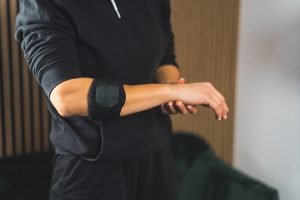
Epiclasps reduce the load on the tendon attachment to the bone allowing the symptoms to settle.
After any activity where the tendon has been loaded, cryotherapy (icing) can keep inflammation to a minimum. An Ice pack or frozen peas (wrapped in a thin towel and used for short periods but with regularity) can be useful.
Long-term, strengthening exercises of the forearm muscles should be considered. Strengthening the muscles also has the benefit of developing the tendons helping them to be more resilient to stress.
Stretching exercises go hand-in-hand with strengthening exercises to maintain suppleness and a good range of movement. Both strengthening and stretching are beneficial to the blood supply to the damaged tissues and of course more widely.
Many patients ask whether they should use pain-killers for Golfer’s or Tennis Elbow. Pain-killers can mask the pain resulting in you unknowingly damaging yourself further.
This does not mean that they should not be used but if pain killers / anti inflammatory medications are taken then it is important to be acutely aware of the tasks in hand so as to avoid further damage.
*It must be noted that Osteopaths do not prescribe medication. All conversations regarding medications are for professional understanding and basic guidance. Patients are encouraged to see their GP or pharmacist for more detailed guidance regarding medicines.
Can osteopathy treat tennis elbow & golfer’s elbow?
If you have tried these approaches and your symptoms haven’t improved then now is the time to book an appointment with Alex Lubel at The Osteopathy Centre in Whetstone, South Woodford or Walthamstow.
Although tendinopathies (tendon problems) can be difficult to treat, osteopathy can be a very effective part of your management plan, helping long term sufferers achieve positive results
Looking more broadly, Alex will consider dysfunctions in the neck, back, shoulder, elbow, wrist and hand and all that is in between. In short his overview and work is holistic.
If your back or elbow go out more often than you do call The Osteopathy Centre.