
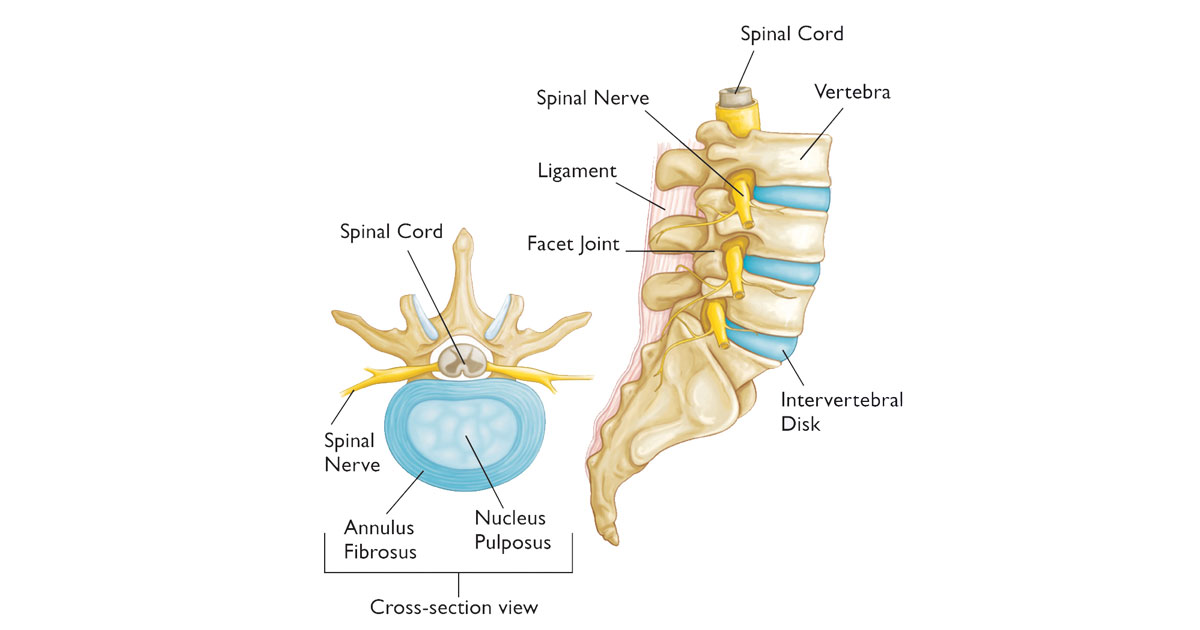
Few phrases cause more unnecessary fear than being told you have a “slipped disc”. Patients often imagine a disc popping out of place or sliding dangerously up and down the spine. Luckily for all of us, this isn’t how the spine works.
At The Osteopathy Centre, I regularly see people who are anxious and concerned and may be avoiding movement because of this misleading term. Let’s clear things up.
What Is a “Slipped Disc” – And Why the Term Is Misleading
First, an important fact: Spinal discs do not slip.
Intervertebral discs are firmly attached between the vertebrae (the bones of the spine) by strong ligaments. They cannot move or slide out of position. What people are usually describing when they say “slipped disc” is one of the following:
- A disc bulge
- A disc protrusion
- A disc herniation
These are all part of a broader, very common process known as degenerative disc disease (DDD) – a term that sounds alarming but is largely a normal part of ageing.
Degenerative Disc Disease: A Normal Process, Not a Diagnosis of Doom
Despite the name, degenerative disc disease is not truly a disease. It describes age-related and load-related changes to the spinal discs that occur in most people – often without pain.
MRI studies consistently show that many people with no back pain at all have disc changes. Pain depends far more on movement, inflammation, sensitivity of the nervous system, and how the spine is being loaded by your shape and the activities you perform, rather than on disc appearance alone. Two patients with similar disc conditions might have totally different pain experiences.
The Stages of Degenerative Disc Changes
Disc changes tend to occur gradually and can be described in stages. Importantly, these stages do not always correlate with pain.
1. Disc Dehydration / Desiccation (Early Degeneration)
- Discs naturally lose water content with age
- They become slightly thinner and less springy
- Often completely painless
- A normal finding from early adulthood onwards
Imagine a slightly stale and squashed jam doughnut.
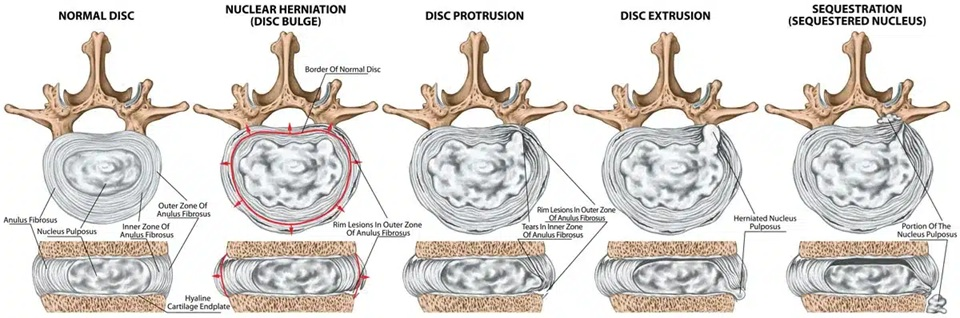
2. Disc Bulge
- The outer fibres of the disc stretch outward evenly
- No tearing of the disc wall
- Common and often asymptomatic
- Frequently reported on scans and over-interpreted
Imagine pressing down on the top of a jam doughnut and the outer edge of the doughnut bulges.
3. Disc Protrusion
- A more localised bulge where the disc pushes further in one direction
- Outer fibres are stressed but still intact
- May cause symptoms if nearby nerves become irritated
Imagine pressing down on the top of a jam doughnut but slightly to one side. You will make the less compressed side of the doughnut bulge a little.
4. Disc Herniation
- A tear in the outer disc fibres allows inner material to push out
- Can irritate or compress a nerve root
- Often painful initially but most herniations improve without surgery
Imagine pressing down on the top of a jam doughnut but slightly to one side. You will make the less compressed side of the doughnut bulge and tear allowing the jam to squeeze out. The jam might just become apparent or may completely exit the disc.
5. Disc Height Loss and Joint Adaptation
- Over time, discs may lose height
- Nearby joints and tissues adapt to changes in load
- This does not mean the spine is “crumbling” (another often misused word) or unstable
- Many people remain active and pain-free at this stage
Why Pain Is Not Just About the Disc
Pain is influenced by many factors:
- Movement patterns
- Muscle tension and weakness
- Joint stiffness
- Inflammation
- Stress and nervous system sensitivity
- Beliefs and fear about damage
This is why two people with very similar MRI reports can feel completely different symptoms.
The Osteopathic Approach at The Osteopathy Centre
At The Osteopathy Centre, I don’t treat scan results – I have a patient-centred approach and treat the person, not the symptom.
My osteopathic approach focuses on restoring function rather than “fixing” a disc and in so doing improve your confidence, movement and greater wellbeing.
1. Thorough Assessment
I assess:
- How your spine moves
- How surrounding joints, muscles, and fascia are functioning
- Your daily activities, work, and exercise habits
- Contributing lifestyle and stress factors
2. Hands-On Treatment
Osteopathic treatment may include:
- Gentle joint mobilisation
- Soft tissue techniques
- Muscle energy and articulation
- Techniques aimed at reducing protective tension and improving movement
All treatment is adapted to the individual and their stage of pain and will only be performed with the patient’s consent.
3. Education and Reassurance
Understanding your condition reduces fear and pain. As such I do my best to explain the issues so you feel informed. I will discuss:
- What your symptoms mean
- What’s normal and safe to move
- Why movement is essential for disc health
4. Movement and Rehabilitation
I will guide you through:
- Gradual return to normal activity
- Strengthening and mobility exercises
- Advice tailored to work, sport, and daily life
Movement is key to health and your recovery.
The Key Message
A “slipped disc” is not something that has popped out of place, and degenerative disc changes are not a life sentence of pain.
With the right support, most people:
- Recover well
- Return to activity – even if modified
- Learn to trust their backs again
If you’ve been told you have a slipped disc or degenerative disc disease and are unsure what it really means, The Osteopathy Centre is here to help you make sense of it – calmly, clearly, and confidently.
If your back – or anything else goes out more often than you do then get in contact with Alex at The Osteopathy Centre on 0203 928 6999 or help@theosteopathycentre.com
The Osteopathy Centre – Helping people like you to feel great every day!